
Home backup is a different problem than camping or tailgating. When the grid goes down, you are not choosing what to power. Your refrigerator compressor needs to start, your sump pump needs to kick on when the float rises, and your CPAP needs to run all night. The power station either handles these loads or it does not.
Most “best power station” lists rank by battery size or price. That misses the point. The gating factor for home backup is surge capacity. A refrigerator compressor surges to 390-414W at startup. A sump pump surges to 3,381W. A standard window AC surges to 2,010W. If the inverter cannot absorb those spikes, it shuts down. Battery size is irrelevant if the compressor never starts.
This guide picks three power stations for home backup based on our database of 33 models evaluated against 49 devices using OEM specs, surge modeling, and conservative load-profile buffers. We did not physically test these units in a lab. We modeled every generator-device pairing through our compatibility engine, which applies real-world derate factors and accounts for startup surge behavior that marketing materials ignore. We do not seek brand diversity for its own sake. We follow the data, and on this segment, the data points where it points.
What “Home Backup” Actually Costs in Energy
Before comparing stations, you need to know what you are actually powering. Here is the realistic daily energy budget for essential home backup.
Minimum daily energy budget (essentials only)
Fridge (French door): 195-207W × 40% duty cycle × 24h = 1,872-1,987 Wh
LED lighting (3-4 rooms): ~50W × 6h = 300 Wh
Phone charging (2 phones): ~15W × 3h = 90 Wh
Wi-Fi router: ~10W × 24h = 240 Wh
Total: approximately 2,500-2,600 Wh per day
The fridge dominates. It accounts for roughly 75% of the daily total. The remaining loads (lights, phones, router) are noise by comparison. This is why fridge compatibility is the first filter for any home backup station.
Add a sump pump at 50% duty cycle during heavy rain and the budget jumps by 460-541W average, roughly 5,500-6,500 Wh per day. Add a window AC and you are above 6,500 Wh per day. At that point, solar recharging or expandable batteries become mandatory for multi-day outages.
How We Pick
Our selection process filters all 33 stations in our database through three gates, in order:
- Voltage gate. Does the station output 120V, 240V, or both? A 120V-only station cannot run a well pump or central AC circuit. This is a hard pass/fail.
- Surge headroom. The station’s peak (surge) rating must exceed the startup spike of every target device with margin. A sump pump surges to 3,381W. If the inverter peaks at 3,000W, the pump never starts.
- Usable energy. Continuous (running) output must cover the device’s steady-state draw, and battery capacity (derated 30% for real-world losses) must deliver meaningful runtime for a multi-day outage.
We do not weight price, brand, or aesthetics. A station either passes the gates or it does not.
Quick Comparison
| Jackery 2000 Plus | EcoFlow DELTA Pro 3 | EcoFlow Delta Pro Ultra | |
|---|---|---|---|
| Price | $2,199 | $3,699 | $5,799 |
| Capacity | 2,042 Wh | 4,096 Wh | 6,144 Wh |
| Running W | 3,000W | 4,000W | 6,000W |
| Surge W | 6,000W | 8,000W | 12,000W |
| 240V | No | Yes | Yes |
| Expandable | Yes (12 kWh) | Yes | Yes |
| Solar input | 1,400W (2× DC8020) | 2,600W (1,600 + 1,000) | 5,600W (4,000 + 1,600) |
| Chemistry | LFP | LFP | LFP |
| Cycles | 4,000 (to 70%)* | 4,000 (to 80%) | 3,200 (to 80%) |
*Jackery rates this model to 70% remaining capacity, not the industry-standard 80%. At an 80% threshold, the effective cycle count is likely closer to 2,500-3,000. See our battery degradation guide for details on threshold differences.
All three stations handle a French door refrigerator (414W surge), sump pump (3,381W surge), and standard window AC (2,010W surge) with margin.
Best Value: Jackery Explorer 2000 Plus ($2,199)
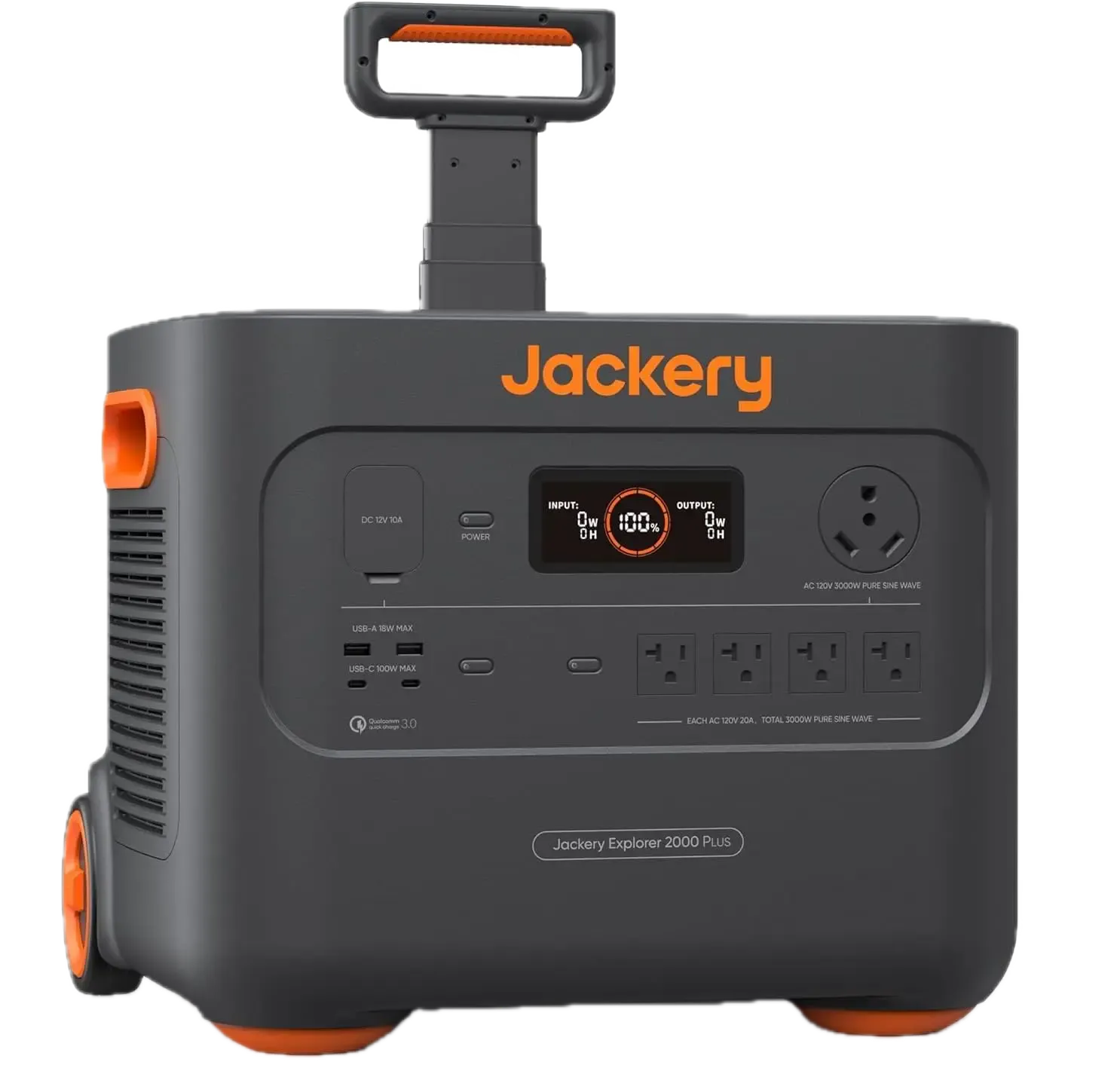
The Jackery Explorer 2000 Plus is the least expensive path to serious home backup. At 3,000W running (continuous output) and 6,000W surge (peak startup capacity), it handles every compressor-driven device in our database that runs on 120V. The fridge starts. The sump pump starts. The window AC starts. That is not a given at this price point.
Pros: 6,000W surge at $2,199 (best surge-per-dollar in our database). Expandable to 12,000 Wh. LFP chemistry. Handles every 120V compressor load we model.
Cons: No 240V output. Proprietary DC8020 solar connectors (locked to Jackery panels). Cycle life rated to 70% threshold, not the industry-standard 80%.
Best for: Fridge + sump pump + window AC on a budget. Buyers who do not need 240V and want the lowest entry price for serious surge headroom.
The 6,000W surge rating exceeds the sump pump’s 3,381W startup by a comfortable margin, and it handles the standard window AC’s 2,010W surge cleanly. At $2,199, no other station in our database offers this combination of surge headroom and expandability.
Expandability. The 2000 Plus accepts additional battery packs up to 12,000 Wh total. At 2,042 Wh base capacity, a single unit covers roughly 20 hours of fridge-only runtime (at 40% duty cycle). Add one expansion battery and you are at 4,084 Wh, enough for a full day of essentials plus a margin for sump pump cycling.
Limitations. No 240V output. If you need to run a well pump, clothes dryer, or central AC circuit, this station cannot do it. Solar input is 1,400W across two proprietary DC8020 ports. Jackery panels use barrel connectors, not the MC4 standard used by most third-party panels. You are locked into the Jackery ecosystem for solar.
Cycle life caveat. Jackery advertises 4,000 cycles, but the fine print specifies a 70% remaining capacity threshold. At the industry-standard 80% threshold, the effective cycle count is closer to 2,500-3,000. This matters if you plan to cycle daily with solar. For emergency backup use (a few cycles per year), calendar aging will limit the battery long before cycle count does.
The math. At 2,042 Wh base capacity with our standard 0.70 real-world derate: 1,429 usable Wh. Divided by the fridge’s 83W average draw (207W × 0.4 duty cycle) = approximately 17 hours of fridge runtime per charge. Add lights, router, and phone charging (~26W average) and that drops to roughly 13 hours.
Best Overall: EcoFlow DELTA Pro 3 ($3,699)
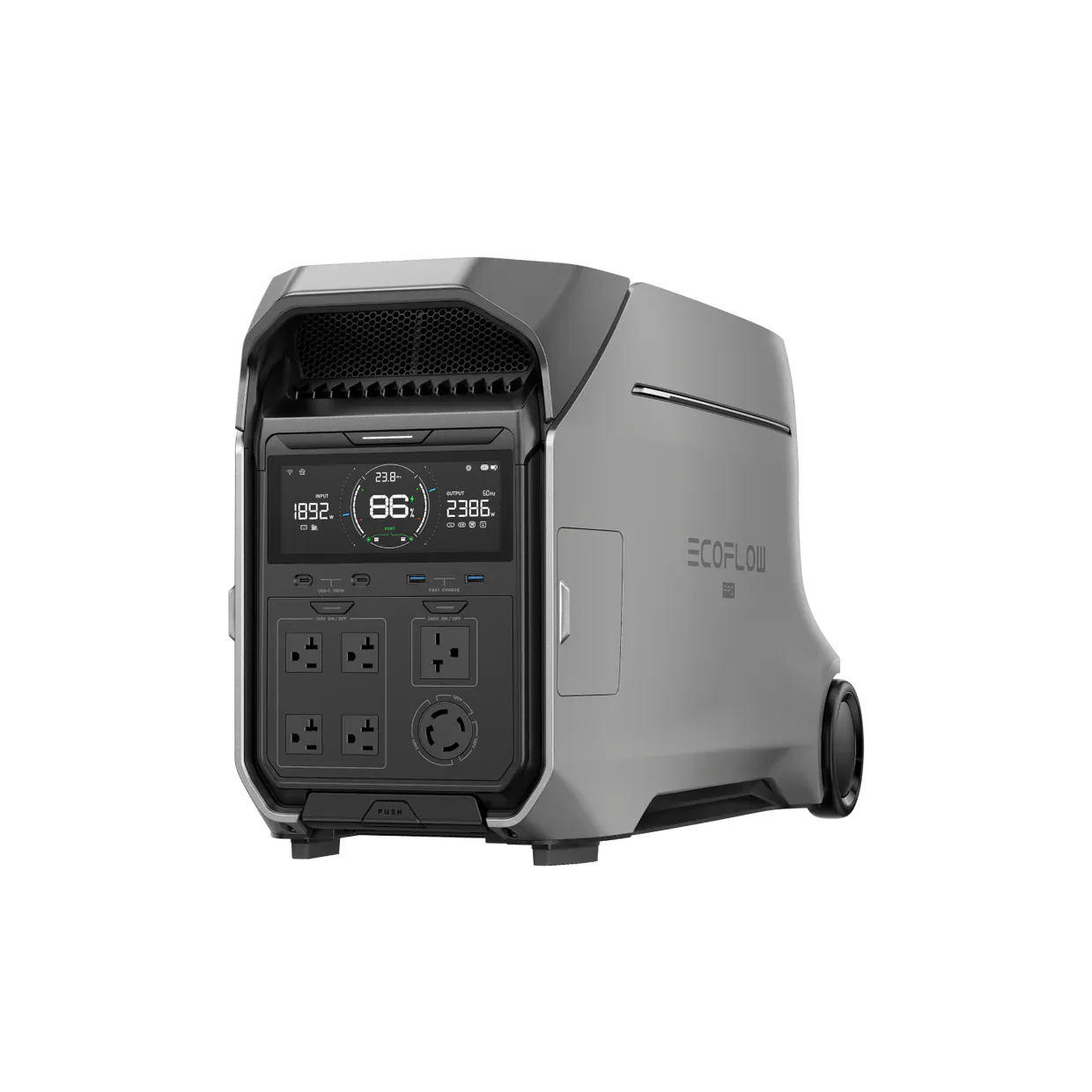
The DELTA Pro 3 is the rational choice for most home backup buyers. It handles 120V and 240V loads, accepts 2,600W of solar input, and its 4,000W running / 8,000W surge specification is sufficient for every residential device in our database except central AC and electric water heaters.
Pros: 240V output (well pumps, 240V sump pumps). 2,600W solar input across two ports. 4,096 Wh base capacity covers 26 hours of essentials. 4,000 cycles to 80%.
Cons: Higher idle draw (~80W per independent testing). $3,699 entry price. Heavier than the Jackery 2000 Plus.
Best for: Most home backup buyers. Anyone who needs 240V, wants strong solar recharging, and plans for 2-3 day outages without expansion batteries.
What it does well. Everything that matters for a 2-3 day residential outage. The 8,000W surge starts a sump pump (3,381W) with more than double the headroom needed. It runs a standard window AC (670-710W running, 2,010W surge) while simultaneously powering a fridge. The 240V output means it can run a well pump, something the Jackery cannot.
Solar input: 2,600W, not 1,600W. The DELTA Pro 3 has two solar input ports: a High-PV port (1,600W, up to 150V) and a Low-PV port (1,000W, up to 60V via XT60i). Combined, that is 2,600W of solar charging capacity. Many reviews cite only the 1,600W High-PV figure. With 400W of panels on each port, a full recharge from solar takes roughly 2-3 hours in strong direct sunlight.
240V capability. For homes with a well pump or a 240V-wired sump pump, this is a critical differentiator. The Jackery 2000 Plus and most stations under $3,000 are 120V only.
The math. At 4,096 Wh with the 0.70 derate: 2,867 usable Wh. At the fridge’s 83W average draw, that is approximately 34 hours of fridge-only runtime. For the full essentials load (fridge + lights + router + phones, approximately 109W average), roughly 26 hours per charge. With 400W of solar panels producing 250-300W real-world output during 5 peak sun hours, you can add 1,250-1,500 Wh per day, extending multi-day outage coverage significantly.
Runner-up: Anker SOLIX F3800 ($3,499). The F3800 offers native split-phase 240V output and expandability up to 26,900 Wh. Its rated spec is 6,000W running / 9,000W surge. Independent testing tells a more nuanced story: Popular Mechanics (April 2025) found the unit ran consistently at loads under 4,000W but overloaded at sustained higher loads. The 9,000W surge held for approximately 45 seconds before throttling. The Solar Lab confirmed similar findings: 9,000W for 2-3 seconds, 7,200W for roughly 10 seconds. At $200 less than the DELTA Pro 3, the F3800 is worth considering if you need split-phase simplicity or plan to build a large expandable system. Size it based on 4,000W continuous rather than the rated 6,000W.
Best Whole-Home: EcoFlow Delta Pro Ultra ($5,799)
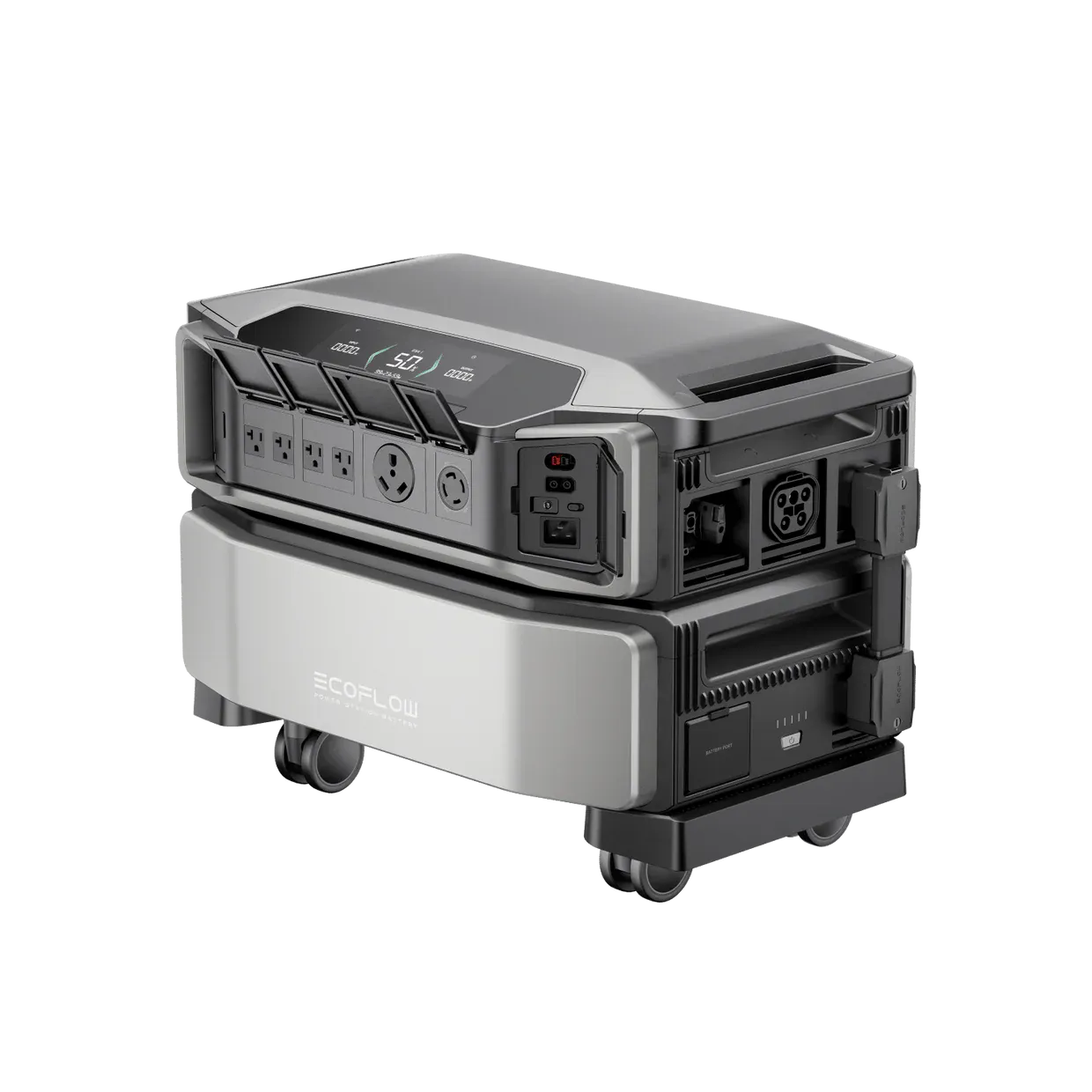
The Delta Pro Ultra is a different category. At 6,144 Wh base capacity, 6,000W continuous output, and 12,000W surge, it is designed for the buyer who wants to run most of a house through a multi-day outage, not just the essentials.
Pros: 12,000W surge absorbs simultaneous compressor startups. 5,600W solar input with industry-standard MC4 connectors. Expandable beyond 90 kWh. 240V output.
Cons: $5,799 base price. ~130 lbs (barely portable). 3,200 cycles to 80% (lower than DELTA Pro 3’s 4,000).
Best for: Buyers running a fridge, AC, and sump pump simultaneously through a multi-day outage. Homes with 240V well pumps. Anyone who needs whole-home coverage, not just essentials.
What it does well. It handles loads that strain or overwhelm every other station on this list. A standard window AC (2,010W surge) plus a French door fridge (414W surge) plus a sump pump (3,381W surge), running simultaneously, total approximately 5,805W of surge. The Delta Pro Ultra absorbs that without approaching its 12,000W peak. No other portable power station in our database offers that margin.
Solar input: 5,600W. The Ultra accepts 4,000W via its primary MC4 solar input (up to 450V) and 1,600W via a secondary MC4 port (up to 150V). With a 1,600W panel array on the primary port, a full recharge from empty takes roughly 4-5 hours of peak sun. The MC4 connectors are industry-standard, compatible with virtually any third-party solar panel.
Expandability. EcoFlow’s stacking system allows multiple Ultra units and expansion batteries. The theoretical ceiling exceeds 90 kWh. At that scale, you are competing with whole-home battery systems like the Tesla Powerwall, not other portable stations.
Limitations. At $5,799 for the base unit alone, this is a significant investment. The unit weighs approximately 130 lbs, which stretches the definition of “portable.” And 3,200 cycles (to 80%) is lower than the DELTA Pro 3’s 4,000 cycles. For daily solar cycling, that is roughly 8-10 years to the 80% threshold. For emergency backup, cycle count is irrelevant.
Who this is for. The buyer who has a well pump on 240V, wants to run an AC unit and a fridge simultaneously through a hurricane, and is willing to pay for the capacity to do it. If your backup scenario is “fridge + lights + phones for 2 days,” this is more station than you need. The DELTA Pro 3 covers that at $2,100 less.
Why We Did Not Pick These
Zendure SuperBase V4600. On paper, 4,608 Wh of capacity looks competitive. But the Zendure’s surge rating equals its running rating: 3,800W for both. There is no surge headroom. A standard window AC surges to 2,010W, a sump pump to 3,381W. Running them simultaneously would demand approximately 5,391W of peak power. The Zendure cannot provide it. For home backup where compressor startups are the gating factor, a 1:1 surge-to-running ratio is disqualifying.
EcoFlow DELTA (Gen 1). Still available at $699, but it uses NMC chemistry with only 800 cycles to 80% capacity. For emergency backup purchased in 2026, LFP is the minimum standard. See our LFP vs NMC guide for why.
Goal Zero Yeti PRO 4000. Excellent idle efficiency (21W, the lowest in our database) and a strong 3,600W/7,200W spec. But at $3,999 it costs more than the DELTA Pro 3 while offering no 240V output, using a proprietary solar connector that limits panel options, and charging more slowly. We reference its idle efficiency in the DELTA Pro 3 section because the stat deserves attention. As a recommendation, the total package has too many tradeoffs for the price.
Sizing Your Home Backup
The right station depends on what you need to protect. Use this framework.
Tier 1: Essentials only (fridge + lights + phones + router). Approximately 2,500-2,600 Wh per day. The Jackery 2000 Plus covers roughly 13 hours per charge. The DELTA Pro 3 covers roughly 26 hours. Add solar and either station can sustain essentials indefinitely during daylight hours.
Tier 2: Essentials + sump pump (heavy rain scenario). Average load jumps to approximately 570W. Daily budget: 5,500-6,500 Wh. You need either an expandable system or daily solar recharging. The DELTA Pro 3 with 400W of solar is the minimum viable setup.
Tier 3: Essentials + sump pump + window AC (summer storm). Average load exceeds 800W during compressor-on cycles. Daily budget: 6,500-8,000+ Wh. The Delta Pro Ultra with solar panels, or the DELTA Pro 3 with expansion batteries and an aggressive solar array. Single-charge solutions do not exist at this load level.
Not sure which tier you need? Our compatibility calculator lets you check any power station against any device in our database. Start there, then come back.
Recommended Reading
Our hurricane battery backup guide walks through multi-day outage planning with priority tiers and solar recharging strategy.
The sump pump battery backup guide explains the surge math for sump pumps and why the 3x NEC multiplier matters.
The battery degradation guide covers cycle life, calendar aging, and the Jackery 70% vs 80% threshold difference in detail.
For budget-conscious buyers, our best power stations under $1,000 guide covers the 12 models below $1,000, with picks by price tier.
And our compatibility calculator lets you check any specific pairing. Every runtime estimate on this page uses the same 0.70 real-world derate factor documented in our sizing guide.
Outage and consumption statistics are historical federal baselines. Your household usage and outage experience may vary by region, utility infrastructure, and weather conditions.
Additional federal sources: EIA, August 2024, EIA, December 2025, EIA Electricity Explained, and EIA FAQ 97.
Related reading
Keep goingState risk
California outage risk profile
State-level outage history, seasonal risks, and backup sizing guidance for California homes.
State risk
Texas outage risk profile
Texas outage risk for heat, storms, and longer-duration home backup planning.
Wildfire Evacuation Power Kit: What to Pack and How to Size It
When evacuating for wildfire, you need communication, medical devices, and lighting — not a whole-house backup. Here is the minimal battery kit that actually works.