
A wildfire evacuation is not a power outage. In a power outage, you stay home and wait. In an evacuation, you leave — sometimes with fifteen minutes of warning, sometimes less. You are in your car, then at a shelter, then at a motel, then maybe at a relative’s house for days or weeks. Your power needs shrink to the essentials: keeping phones alive for emergency alerts and coordination, running a CPAP machine at night, and having a light source that does not depend on the grid.
This guide assumes you are evacuating by car with limited access to wall outlets for 24 to 72 hours. If you are sheltering in place during a planned power shutoff (PSPS), or preparing for a week-long grid outage without mobility, the sizing math is different — see our hurricane battery backup guide or how to size a power station for those scenarios.
Every number in this article comes from OEM specifications or conservative estimates verified against our device database. If you live in a wildfire-prone area — and the wildfire-urban interface included about 44.1 million U.S. homes (32% of U.S. housing) in USDA’s 2020 estimate — this is the kind of preparation that works best when done in May, not when smoke is visible on the horizon.
First Priority: Communication, Not Capacity
Before you think about power stations and watt-hours, make sure your immediate communication needs are covered with gear that requires zero setup.
Phone + USB power bank. A 10,000 mAh USB power bank (~$15, fits in a pocket) charges a phone 2 to 3 times. This is your plan B if the power station is dead, forgotten, or inaccessible. Keep one in your go-bag and one in your car’s glove box. You can buy one at any gas station — you cannot buy a power station during an evacuation.
AM/FM radio. Cell towers fail during wildfires — overloaded, burned, or cut from power. A battery-powered or hand-crank AM/FM radio receives NOAA Weather Radio and local emergency broadcasts without depending on cell service. This is not optional. It is the communication method that works when everything else fails.
LED headlamp. Battery-operated (AAA or rechargeable), hands-free, and independent of your power station. No configuration, no cables, no inverter.
These three items weigh under one pound combined and cover your communication and lighting needs regardless of whether your power station works. Everything below this point is about extending your capability — not about survival.
Evacuation Is Not Home Backup
Home backup planning optimizes for capacity: how many watt-hours do you need to ride out a 24-hour outage while running a refrigerator, lights, and a router? Evacuation planning optimizes for a different set of constraints entirely.
Weight matters. You are carrying this to your car, from your car to a shelter, and possibly up stairs at a motel. A 100-pound expandable system is a home backup solution, not an evacuation tool. Your evacuation kit should weigh under 25 pounds total, including the power station, cables, and any accessories.
Portability matters. You may need to fit the station in a backpack, a duffel bag, or between luggage in a packed trunk. Compact form factor is not a luxury — it is a requirement.
Recharging matters more than capacity. You will likely have access to a car for driving, which means you have a 12V charging source. A smaller station that recharges from a car outlet during the drive to your evacuation destination may be more practical than a larger station that lasts longer but cannot recharge on the road.
Your power needs are minimal. During evacuation, you need to charge phones, run a medical device if applicable, and have lighting. You do not need to run a refrigerator, an air conditioner, or a home office.
What You Actually Need to Power
Here is a realistic power budget for a family of four during evacuation:
| Device | Watts | Daily hours | Daily Wh |
|---|---|---|---|
| Phone charging (4 devices) | ~20W each | 2–3 | 160–240 Wh |
| LED lantern (USB rechargeable) | 5–10W | 6–8 | 30–80 Wh |
| CPAP machine (if needed) | 39–56W | 8 | 312–449 Wh |
| Laptop (for communication) | 45–65W | 2–3 | 90–195 Wh |
Without a CPAP, a family’s daily evacuation power budget is approximately 280–515 Wh. That is well within the range of a single compact power station.
With a CPAP, the budget jumps to 592–964 Wh per day. The CPAP machine is the single largest draw in an evacuation scenario — roughly half the total daily budget. The wattage range reflects real differences across models: a Fisher & Paykel SleepStyle draws 39W, a ResMed AirSense 10 draws 53W, and a ResMed AirSense 11 draws 56.1W (all from OEM user guides). If you use a CPAP, know your model’s exact wattage — it determines which station you need. See our CPAP battery backup guide for model-specific runtime calculations.
Station Sizing for Evacuation
Tier 1 — Phones, lights, and basic communication (no CPAP)
Need: 300–500 Wh per day. Compact, under 10 pounds.
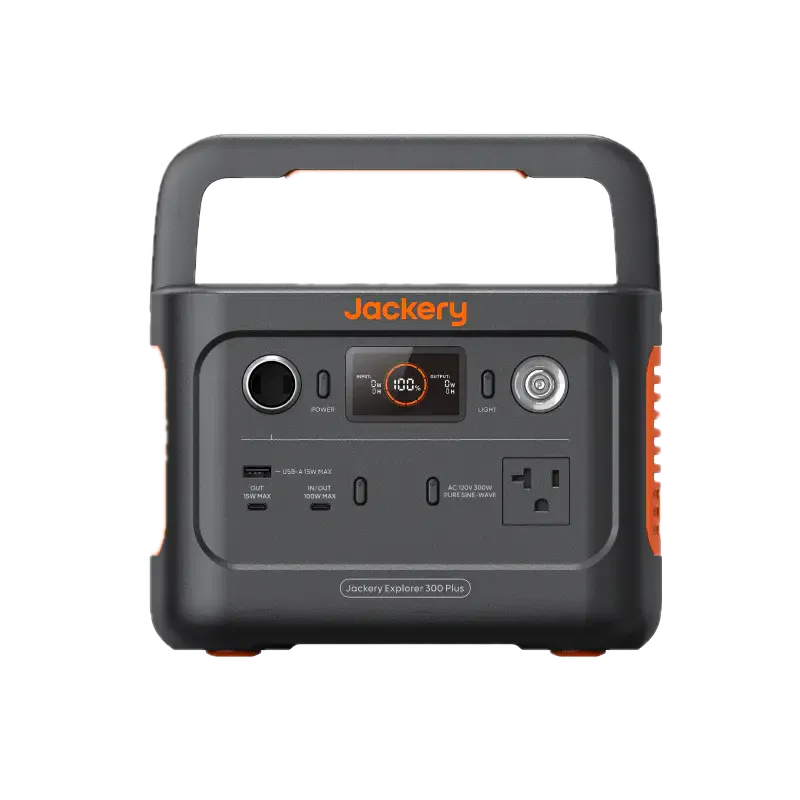
The Jackery Explorer 300 Plus covers a full day of phone charging and LED lighting for a family of four. At 288 Wh with a 0.70 real-world derate, you get approximately 202 usable watt-hours — enough for phone charging and a light. It charges from a car’s 12V outlet, which makes it practical for evacuation driving.
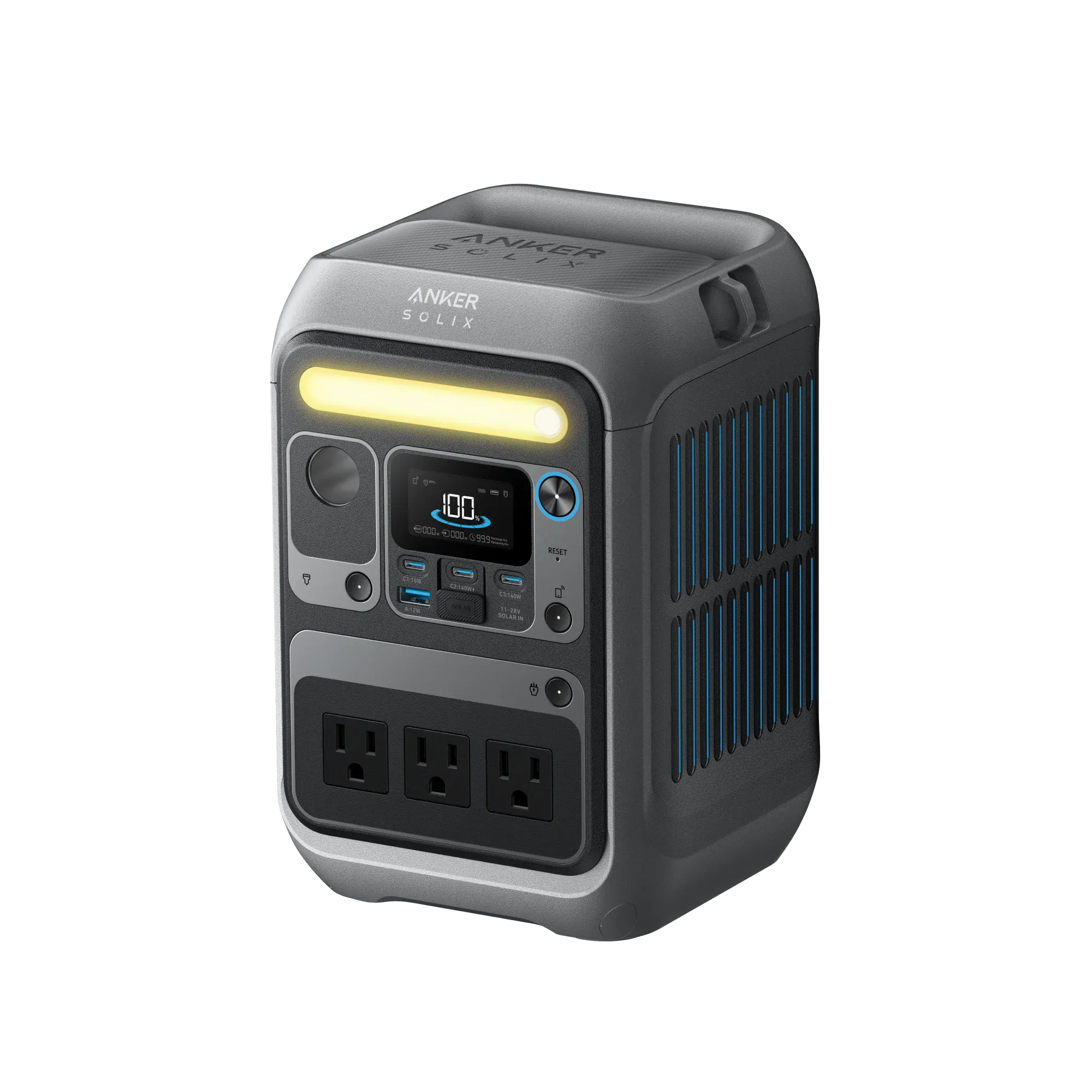
The Anker SOLIX C300 is in the same class. It adds a 140W USB-C output for fast-charging laptops directly, without using the AC inverter — exactly the kind of DC efficiency that extends battery life in an evacuation scenario.
At this tier, you are trading capacity for portability. One day of phone and light usage is covered. If the outage extends, you recharge from your car.
Tier 2 — CPAP user or multi-day displacement
Need: 700–1,100 Wh per day. Under 25 pounds.
The Jackery Explorer 1000 v2 is the practical choice for CPAP users during evacuation. At 1,070 Wh with a 0.70 derate, you get approximately 749 usable watt-hours. A ResMed AirSense 11 at 56.1W runs for approximately 13.4 hours on a single charge — comfortably more than one night. Add phone charging and a light and you still cover a full night plus the next morning.
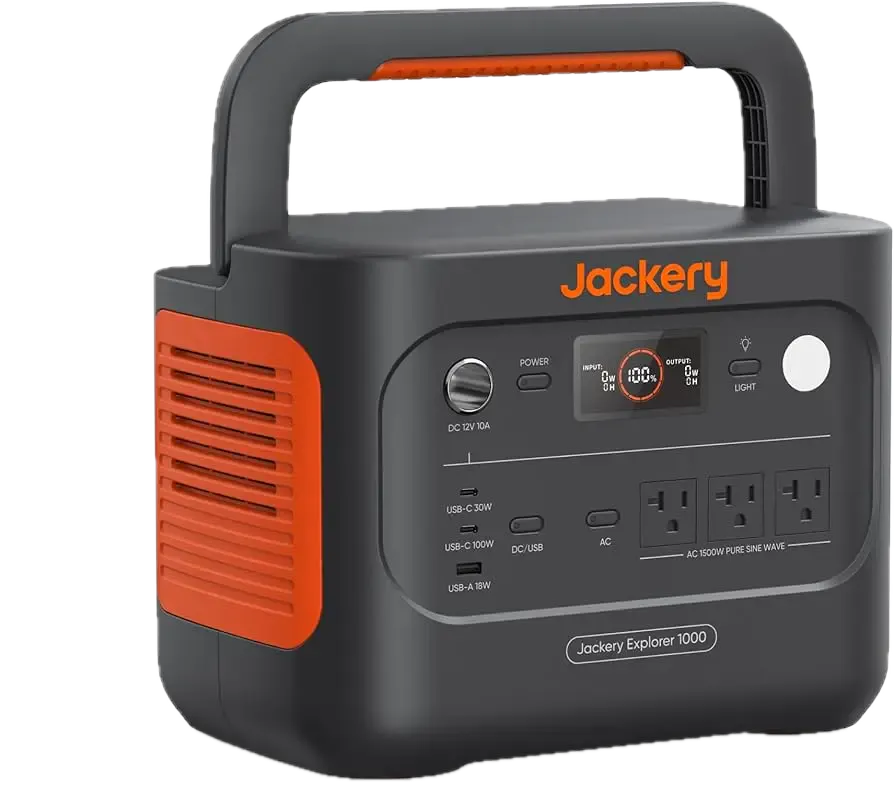
Jackery Explorer 1000 v2
CPAP runtime on Jackery Explorer 1000 v2
1,070 Wh × 0.70 derate / 56.1W = 13.4 hours (ResMed AirSense 11)
At 24.2 pounds, the Jackery 1000 v2 is at the upper limit of what most people would carry during evacuation. It fits in a car trunk easily but is not something you want to carry up three flights of stairs. If your CPAP draws less power (Fisher & Paykel SleepStyle at 39W = 19.2 hours runtime), the math is even more comfortable.
Which tier do you need?
| Scenario | Tier | Station class | Weight |
|---|---|---|---|
| Family, no medical devices | Tier 1 | 288 Wh / 300W | ~8 lbs |
| Solo with CPAP | Tier 2 | 1,070 Wh / 1,500W | ~24 lbs |
| Family with CPAP | Tier 2 | 1,070 Wh / 1,500W | ~24 lbs |
| Multiple medical devices | See our medical device planning guide | Varies | Varies |
Our best power stations for CPAP machines page shows which units in our database meet CPAP requirements, including compact models suitable for evacuation.
Your Primary Recharging Strategy: The Car
During a wildfire evacuation, the most reliable power source you have is your vehicle. Every power station in our database accepts 12V DC input from a car’s cigarette lighter or accessory outlet. This is not a backup recharging plan — for evacuation scenarios, it is the primary one.
How car charging works. The power station plugs into your car’s 12V outlet via a DC charging cable. While the engine is running, the alternator provides power and the car battery is not drained. Most car 12V outlets are fused at 10A to 15A, which limits charging to approximately 100 to 150W depending on the vehicle. Some stations cap their 12V input lower — check your station’s manual for the actual rate.
Charging time math. A Jackery Explorer 300 Plus at 288 Wh charging at approximately 65W from a car outlet takes roughly 4.5 hours to fully recharge. A Jackery Explorer 1000 v2 at 1,070 Wh takes approximately 9 to 11 hours at 100W input. In practice, you are charging during the drive to your evacuation destination and while running errands — not sitting in an idling car.
Keep the car charging cable in the kit. This is the single most important accessory in your evacuation power kit. The station itself is useless on day two if you cannot recharge it. Do not assume the cable was in the box — some manufacturers do not include a 12V car cable in the base package. Check now, not during the evacuation. The cable should be in the same bag as the station.
For vehicles with USB-C Power Delivery ports (common in 2022+ models), you can charge phones directly from the car without using the power station at all — saving station capacity for devices that need AC power, like a CPAP machine at night.
Solar: A Supplement, Not a Solution
A portable solar panel can supplement your car charging, especially if you are displaced for days or weeks at a location without reliable grid power. But for wildfire evacuation specifically, solar has limitations that are often underestimated.
The real-world math
A 100W portable solar panel does not produce 100W for 10 hours and deliver 1,000 Wh per day. Here is what it actually delivers.
Rated output vs. real-world output. The 100W rating is at Standard Test Conditions (STC): 1,000 W/m² irradiance, 77°F (25°C) cell temperature, air mass 1.5. In real-world conditions, expect 50 to 85W of peak output in direct sunlight (confirmed by independent tests from Outdoor Gear Lab and similar sources). The simple rule: expect 2 to 3x longer charge times than marketing materials suggest.
Productive sun hours. In clear summer conditions in the western US, you get approximately 5 to 6 hours of strong direct sunlight. But “strong direct sunlight” does not mean rated output for all of those hours. A reasonable estimate for total daily production from a 100W panel is 300 to 420 Wh on a clear day — not 1,000 Wh.
Realistic daily solar production
100W panel × 0.70 derate × 5–6 productive hours = 350–420 Wh per clear day
For a Jackery Explorer 1000 v2 at 1,070 Wh, a 100W panel produces roughly one third of a full charge per clear day — not a full charge. To fully recharge from solar alone, you would need three clear days or a 300W panel array.
Wildfire smoke kills solar output
This is the critical factor that generic solar advice ignores. Wildfire smoke reduces solar irradiance dramatically. Research on major wildfire events suggests smoke plumes can reduce surface solar radiation by roughly 50 to 80% depending on smoke density and proximity to the fire. During the 2020 West Coast fires, parts of Oregon and California experienced daytime conditions so dark that streetlights activated.
A 100W panel producing 350 Wh on a clear day might produce 70 to 175 Wh through moderate wildfire smoke — barely enough to charge four phones. If you are evacuating because of a wildfire, do not count on solar as a reliable recharging source. It is a supplement for after the smoke clears, not a strategy for the first days of evacuation.
Our solar charge time estimator calculates recharge time for any panel and station combination in our database, using the 0.70 real-world derate factor.
Clean Air: An Overlooked Use for Battery Power
Wildfire smoke contains fine particulate matter (PM2.5) that penetrates buildings, vehicles, and shelters. If you are at a motel, a relative’s home, or an evacuation center with poor air filtration, a small HEPA air purifier running on battery power can create a breathable zone in a single room.
A compact HEPA purifier draws approximately 30 to 50W on its low-to-medium setting. On a 288 Wh station at 0.70 derate, that is roughly 4 to 7 hours of filtered air — enough for a night of sleep in a smoky environment. On a 1,070 Wh station, you get 15 to 23 hours.
This is not a core recommendation — communication and medical devices come first. But if you have capacity to spare and smoke exposure is a concern, a purifier is a high-value use of remaining battery power. The purifier itself must already be part of your kit; buying one during an evacuation is unlikely.
The Evacuation Power Kit Checklist
CAL FIRE’s wildfire preparedness guidelines emphasize keeping flashlights, extra batteries, and phone chargers in your go-bag. The checklist below extends that guidance with a complete power plan sized to your specific needs.
Wildfire Evacuation Power Kit Checklist
Must-have: communication and immediate safety
- USB power bank (10,000 mAh) — pocket-sized, charges phones 2–3x without a station
- LED headlamp with fresh batteries
- Battery-powered or hand-crank AM/FM radio
- N95 masks (one per person — wildfire smoke is a respiratory hazard)
- Eye protection or lubricating eye drops (smoke irritation)
- Cash (small bills — ATMs and card readers fail without power)
- Copies of insurance documents, IDs, and medical prescriptions (paper, in a waterproof bag)
Station and cables (pack together in one bag)
- Power station — fully charged and tested
- 12V car charging cable — verify it is in the bag now, not during evacuation
- AC wall charger (for when you reach a location with grid power)
- USB-C cable for each phone
- USB-A cable if any devices need it
- Short power strip or multi-outlet adapter
Medical devices (if applicable)
- CPAP machine with AC power cord
- CPAP DC adapter cable (if your model supports 12V/24V direct — bypasses inverter, saves 20–30% battery)
- Any other medical device with its power cord
- Written note of device wattage and nightly Wh need
Nice-to-have: extended displacement
- 100W portable folding solar panel + panel-to-station cable
- USB-rechargeable LED lantern (backup to headlamp)
- Small HEPA air purifier (if smoke exposure is expected)
Annual test (complete in May, before fire season)
- Full charge-and-run test: charge station to 100%, run your devices, record actual runtime
- Car charging test: plug station into 12V outlet with engine running, confirm it charges
- Cable check: all cables present and undamaged
- Battery health: compare runtime to last year (flag if >20% decline)
- Verify go-bag location: near exit or in vehicle
Storing Your Kit Year-Round
A wildfire evacuation kit works only if it is ready when you need it. LFP (lithium iron phosphate) batteries — used in all three stations discussed in this article — are well-suited to long-term standby storage.
Storage charge level. If you are not using the station regularly, store it at 50 to 80% charge. LFP chemistry tolerates this range well for months. Check the charge level every two to three months and top up if it drops below 40%.
Temperature. Store the station in a climate-controlled area if possible. LFP batteries tolerate heat better than NMC chemistry, but sustained temperatures above 100°F (38°C) will accelerate degradation. A garage in Phoenix in July is not ideal long-term storage — an interior closet is better.
Location. Keep the kit near your home’s exit or in your vehicle. The goal is zero packing time during an evacuation: grab the bag and leave. If the station lives in a closet on the second floor, it will not be in your car when you need it.
Recommended Reading
Our CPAP Machine Battery Backup Guide covers model-specific runtime calculations for every CPAP in our database.
The How to Size a Portable Power Station guide walks through the complete sizing framework, including the 0.70 derate factor used in this article.
For broader emergency preparation covering hurricanes, ice storms, and extended outages, see the Hurricane Battery Backup Guide and the Winter Storm Heating Guide.
The Medical Device Power Outage Planning Guide addresses multi-device medical households with a printable checklist.
And our solar charge time estimator calculates real-world recharge time for any panel and station combination.
Wildfire exposure and outage impacts are based on historical or modeled federal datasets. Local risk and evacuation timelines vary by county, vegetation, weather, and incident response conditions.
Additional federal sources: USDA Forest Service WUI assessment (2020) and USDA Fire-Adapted Communities.
Related reading
Keep goingState risk
California outage risk profile
Wildfire-related outage risk, evacuation scenarios, and home backup planning.
Best Portable Power Stations for Home Backup (2026): Outage-Ready Picks
For home backup, you need surge capacity for fridge compressors and enough Wh for multi-day outages. Here are the best options from our database of 33 stations.